
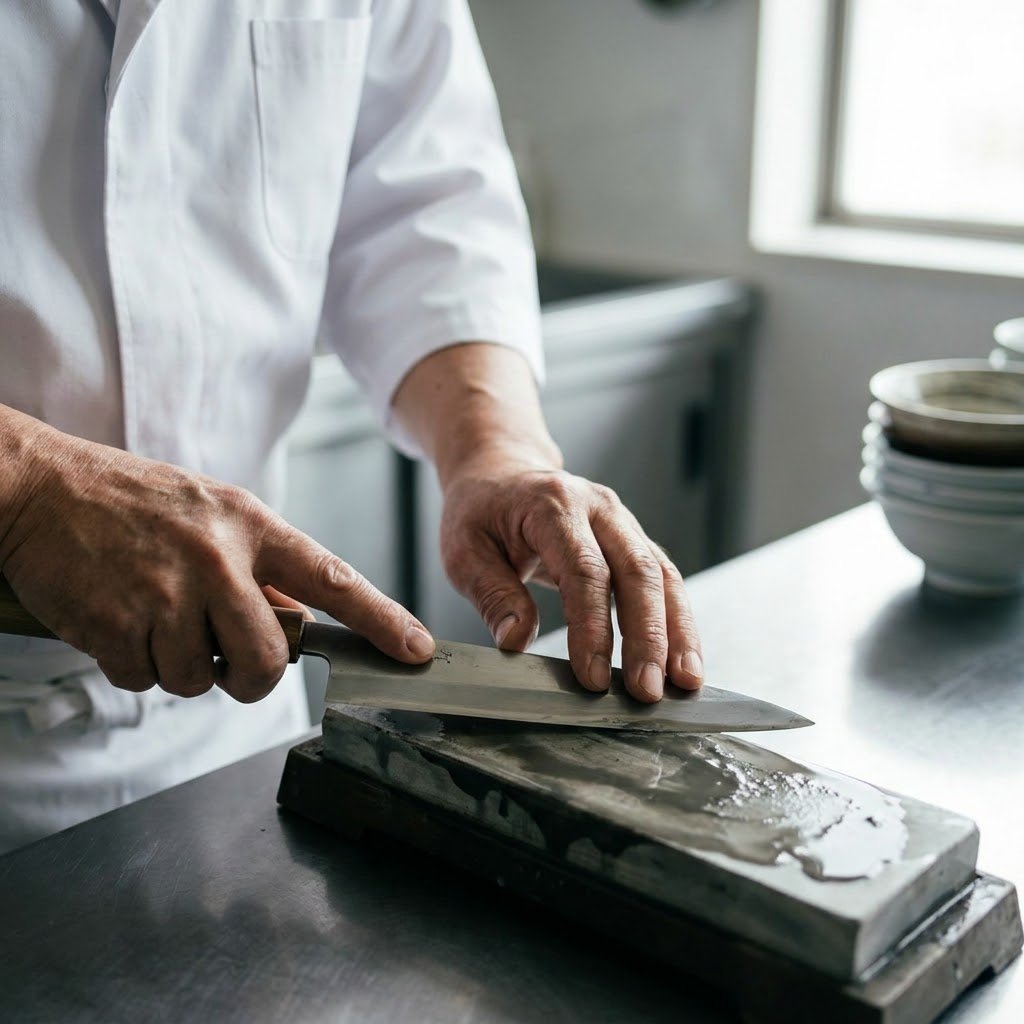
A chef’s knife is far more than a simple kitchen utensil; it is the silent conductor of culinary artistry. The ultimate quality of any dish, from the delicate texture of sashimi to the crispness of julienned vegetables, is fundamentally dictated by the sharpness of the blade. Traditional Japanese knives (Wahocho), renowned for their masterful design, represent a zenith of cutting performance.
At the heart of this performance is the Kataba (single-bevel) structure, in contrast to the Ryoba (double-bevel) design common in Western cutlery. The single-bevel design allows the blade to slice through food with absolute precision, sliding smoothly to prevent food from sticking, and cleanly slicing through ingredients without bruising or destroying their delicate cellular structures. This preservation of food fibers ensures that natural flavors, juices, and aesthetic beauty are kept perfectly intact.
However, possessing such an extraordinary tool carries a responsibility. While Japanese knives are capable of lasting for decades, their legendary performance can easily deteriorate within a short period without proper care [90]. Mindful and disciplined maintenance is not merely a chore; it is an act of respect toward the culinary craft that transforms a fine knife into a lifelong companion.
1. The Daily Routine: Wash, Dry, and Store
Rust and metal degradation are almost entirely caused by the prolonged presence of moisture and food residue. Establishing a disciplined daily routine around three basic pillars is essential to maintaining your knife’s integrity.
- Washing Immediately After Use: Never allow a dirty knife to sit in the sink. Food acids (such as from citrus, tomatoes, or vinegared foods) and salts will corrode even stainless steel if left untouched. Wash the blade using a mild, neutral dish soap and a soft sponge. Never use abrasive scouring pads or steel wire brushes, as they will scratch and compromise the polished surface. For safety and control, firmly hold the handle and wipe the blade from the spine toward the edge. Pay special attention to the transition zone between the blade and the bolster (or handle), as this area easily accumulates organic residue and is prone to decay.
- Meticulous Drying (The Hot Water Technique): After washing, rinsing thoroughly is crucial. Then, to ensure absolute dryness, perform this highly effective traditional technique: pour a small amount of hot water over the blade. The heat from the water will warm the steel, causing any remaining microscopic water droplets to rapidly evaporate upon wiping. Follow this by thoroughly wiping the blade, handle, and bolster with a clean, dry cloth. Avoid placing wood-handled knives in heated drying chambers, as the abrupt temperature changes can cause the wooden fibers to shrink and warp.
- Secure Storage: Store the completely dried knife in a well-ventilated, secure area. Utilizing a dedicated wooden block, sheath (Saya), or magnet holder prevents the sharp edges from colliding with other metal utensils, which can cause subtle, irreversible chipping.
2. The Art of Sharpening: Restoring the Edge
A dull knife is not only inefficient; it is inherently dangerous, as it requires excess force and is prone to slipping. Do not wait until your knife is completely dull to sharpen it; minor, regular touch-ups yield the best results with minimal effort.
- Selecting the Whetstone: For standard domestic kitchen maintenance, a single medium-grit whetstone (around #1000) is more than sufficient for restoring a beautiful, clean edge. To elevate your edge to professional levels of friction-free cutting, a fine finishing stone (#3000 to #6000) can be introduced afterward.
- Preparation: Fully submerge the whetstone in water for 10 to 15 minutes before sharpening, ensuring it has absorbed ample water (indicated when air bubbles stop rising). Place the stone on a flat surface over a damp towel to keep it completely stable and prevent sliding.
- Technique and Angle: Hold the handle firmly and place the fingers of your free hand lightly onto the face of the blade to stabilize it. Maintaining a consistent angle is the single most critical factor. Keep the blade elevated at approximately 15 degrees from the flat stone surface, which is roughly equivalent to the thickness of two coins stacked together.
- The Motion: Apply gentle, even pressure and stroke the blade rhythmically across the full length of the stone. Push the blade forward with slight, focused pressure, and relax your fingers as you pull it back. Continue until you feel a uniform Burr (or Kaeri—a microscopically curled metal edge) forming along the entire opposite side of the blade.
- Single-Bevel vs. Double-Bevel:
- Double-Bevel (Ryoba): Sharpen both faces of the blade, typically maintaining a 6:4 ratio of strokes between the front and back face.
- Single-Bevel (Kataba): Focus exclusively on sharpening the front bevel face until a burr appears. Once the burr is established along the entire length, lay the flat back face of the blade completely flat against the whetstone and stroke it lightly to cleanly wipe away the burr.
- Whetstone Maintenance: As you sharpen, the center of the whetstone will naturally wear down and dish. Regularly use a flatting stone (or flattening tool) to keep the whetstone’s surface perfectly flat, as a dished stone will prevent a uniform edge and damage the blade profile.
3. Crucial Prohibited Practices
Avoiding harmful habits is just as important as active maintenance. To protect your investment, strictly avoid the following practices:
- Dishwashers: The intense heat, humidity, and aggressive chemical detergents in a dishwasher will dry out wood, causing the handle to crack, splitting wooden fibers, and corroding the steel edge. Physical collisions with other tableware during the wash cycle can also lead to severe chipping.
- Cutting Unsuitable Foods: Never use thin, specialized vegetable or slicing knives to cut through frozen foods, large bones, or hard seeds. Doing so causes immediate, deep structural chipping, especially in high-hardness steel blades.
- Applying Direct Heat: Never heat your knife over an open gas flame. High temperatures will ruin the metal’s factory-applied heat treatment (tempering), permanently destroying the steel’s molecular hardness and rendering it unfixable.
- Harsh Chemicals: Avoid bleaching agents or soaking your knives in harsh corrosive fluids, which will pit and corrode the metal.
- Improper Cutting Surfaces: Never use glass, ceramic, or stone cutting boards, as they cause immediate and severe blunting of the delicate blade edge. Always select high-quality wood or soft synthetic resin cutting boards.
4. Long-Term Preservation & Wooden Handle Care
- Caring for the Wooden Handle: Traditional wooden handles (such as magnolia wood, wenge, or ebony) must not be ignored. To maintain their beautiful organic texture and ensure water resistance, apply a thin coat of food-safe oil (such as walnut or linseed oil) directly to the wood handle once a month. Let it absorb, then gently wipe away any excess. If you ever notice the handle becoming loose or wobbly, cease using the knife immediately to prevent injury and have it professionally repaired.
- Long-Term Preservation: If a knife is to be left unused for a long period, apply a microscopic coat of safe vegetable oil (like camellia oil or salad oil) over the entire dry metal surface. Then, wrap the blade tightly in dry newspaper and store in a low-humidity drawer. The newspaper acts as a physical barrier absorbing any ambient humidity, while the mineral-rich oils in the printing ink work cooperatively as an exceptional rust preventative.
5. Conclusion
Embracing the routines of knife care is not merely about preserving metal; it is about cultivating a mindful relationship with the tools that feed us. A beautifully maintained Japanese knife provides fluid, effortlessly clean cuts that make every preparation a joyous experience. By treating your knife with respect, you deepen your connection to the rich culinary traditions of Japan, ensuring that your trusted blade remains sharp, safe, and ready to craft culinary masterpieces for generations to come.