
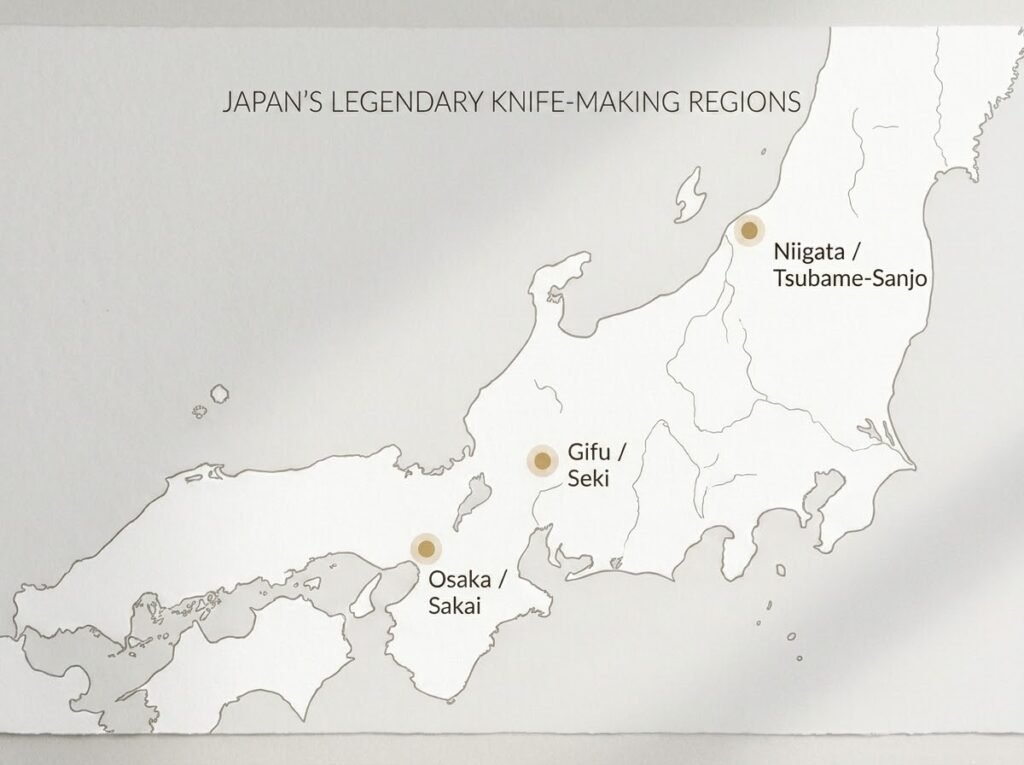
Selecting a blade is a ritual—a defining moment in one’s culinary journey. For those who cherish the art of cooking, a knife is the most intimate of partners. However, with the overwhelming variety of shapes like Santoku or Yanagiba, many find themselves lost. In this guide, we shall illuminate the unique souls of Japan’s premier knife-making regions to help you find your perfect match.
When seeking your first serious knife, it is common to gravitate toward famous brands. Yet, the true essence of a Japanese blade lies in its “production area.” The three major regions—Sakai, Seki, and Tsubame-Sanjo—each possess a distinct history and philosophy of manufacturing. By understanding these regional strengths, you can select a tool that resonates with your lifestyle and culinary aspirations.
First, let us step into the world of “Sakai,” the sacred land of traditional Japanese knives, held in the highest esteem by professional chefs.
Sakai: The Zenith of Traditional Wa-hocho
Sakai knives carry a prestige that commands the Japanese culinary world. It is said that 90% of professional chefs in Japan choose Sakai blades. The lineage of Sakai’s craftsmanship dates back to the 5th century, beginning with tools used to construct the great Nintoku-ryo mound. Later, the region’s fame was cemented in the 16th century with the production of “Tabako-bocho” (tobacco knives). Their quality was so exceptional that the Tokugawa Shogunate granted them the “Sakai-kiwame” seal of authenticity, spreading their renown across the nation.
The hallmark of Sakai production is a “complete division of labor,” a sophisticated system that ensures uncompromising quality through specialization:
- Forging: Master blacksmiths forge the soul of the blade from raw steel.
- Sharpening: Specialized artisans sharpen the blade to a microscopic edge.
- Handle Fitting: Craftsmen ensure the knife feels like a natural extension of the hand.
A Sakai knife’s specialty is its single-bevel carbon steel construction. Unlike mass-produced blades, it is designed “not to crush the cells” of the ingredients. When slicing sashimi, the sharp edge severs fibers cleanly, preventing juices from leaking. This leaves the cut surface glistening and preserves the pure, vibrant flavor of the food.
Who is a Sakai knife for?
“For the culinary purist who views cooking as an art form. It is the ideal companion for those who take pleasure in the ritual of maintenance and the pursuit of professional-grade sashimi and Japanese cuisine.”
In contrast to the ancient traditions of Sakai, let us now look toward “Seki,” where samurai heritage meets modern technological elegance.
Seki: The Fusion of Damascus Beauty and Modern Yo-hocho
Seki City is celebrated as one of the “World’s Three Great Cutlery Capitals.” Its history was forged by sword-smiths who settled there for the high-quality soil and water. Legends like Date Masamune favored Seki swords for their resilience. When the “Sword Abolition Edict” (Haitorei) arrived in 1876, these craftsmen channeled their ancestral skills into kitchen knives, creating a unique harmony between industrial precision and artisan handiwork.
Seki excels in high-quality stainless steel “Yo-hocho” (Western-style knives). Renowned brands like Seki Magoroku and Misono are born here. These blades often feature the mesmerizing rippling patterns of Damascus steel, offering an aesthetic beauty that complements their rust-resistant functionality.
Comparison: Sakai vs. Seki
| Feature | Sakai | Seki |
|---|---|---|
| Structure | Single-bevel / Wa-hocho | Double-bevel / Yo-hocho |
| Primary Materials | Carbon Steel / Hagane | High-quality Stainless |
| Maintenance | High (Rusts easily) | Standard (Rust-resistant) |
| Aesthetics | Traditional Functional Beauty | Stunning Damascus Patterns |
While Seki represents the bridge between tradition and technology, our final destination, “Tsubame-Sanjo,” embodies the pinnacle of minimalist utility.
Tsubame-Sanjo: Minimalist Utility and Effortless Maintenance
The craftsmanship of Tsubame-Sanjo began as an act of salvation. In the Edo period, nail-makers were invited from Edo to help farmers who suffered from frequent river flooding, leading to the production of “Wakugi” (Japanese nails). This foundation evolved into a mastery of metalworking, eventually birthing the revolutionary “all-stainless steel integrated” knife. Global brands like GLOBAL and Tojiro have redefined modern kitchen standards from this region.
The brilliance of the all-stainless design lies in its seamless hygiene. With no gap between the blade and handle, bacteria have no place to hide. Many models are also dishwasher-safe, making them the ultimate “first acquisition” for the busy modern cook or the minimalist who seeks effortless elegance.
Navigation: The Quick Match Guide
Does your culinary soul align with tradition, beauty, or utility? Check the boxes that speak to your style.
- The Professional / Traditionalist (Sakai)
- I want to master the delicate art of sashimi.
- I value the soul and heritage of hand-forged crafts.
- The Modern Home Cook (Seki)
- I want a blade that is as beautiful as it is sharp.
- I seek a high-end knife that resists rust.
- The Busy Beginner / Minimalist (Tsubame-Sanjo)
- Hygiene and ease of care are my top priorities.
- I want a modern, reliable multi-purpose tool.
Choosing a kitchen knife is more than just selecting a tool; it is choosing the lifestyle you wish to lead and the way you approach the ingredients that sustain you. Whether you choose the unrivaled sharpness of Sakai, the artistic technology of Seki, or the practical minimalism of Tsubame-Sanjo, your blade will become a silent witness to your culinary evolution.
Cherish your knife, treat it with respect, and it will serve you faithfully for a lifetime.