
1. Introduction: The Soul of the Blade
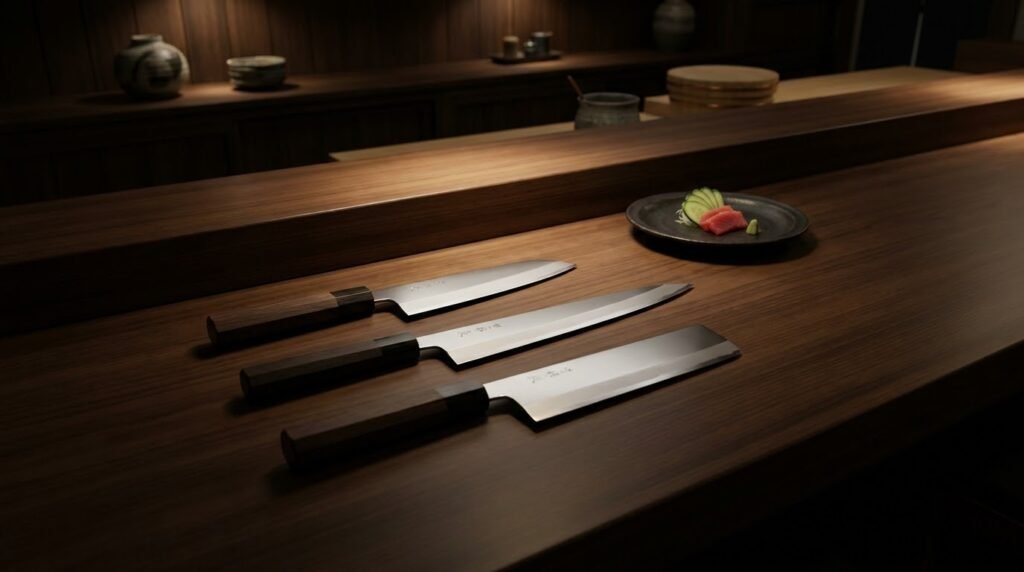
Listen closely, and you will hear the rhythmic shh-shh of a high-carbon steel blade meeting a water-soaked whetstone. For a bladesmith, this is the heartbeat of the kitchen. A Japanese knife is not merely a utensil; it is a living instrument forged to glide through the cell walls of an ingredient without bruising its essence. When a blade is truly sharp and correctly designed, it doesn’t just cut; it respects the food.
The primary architectural distinction you must understand is the difference between the Kataba (Single-bevel) and the Ryoba (Double-bevel). Traditional Japanese blades often favor the Kataba design, featuring a flat or slightly concave back (urasuki) that creates an air pocket between the blade and the food. This allows the steel to enter the ingredient at a precise angle, ensuring a smooth release and preventing delicate fibers from sticking or tearing.
| Feature | Kataba (Single-bevel) | Ryoba (Double-bevel) |
|---|---|---|
| Structure | Sharpened on one side only; the back is often concave to aid food release. | Both sides are sharpened to a symmetrical “V” shape. |
| Cutting Style | Enters at an angle; requires technique to prevent the blade from “veering.” | Cuts straight through the center of the ingredient. |
| Primary Benefit | Exceptional precision; leaves a non-bruised, glossy surface on food. | Perfectly balanced; highly intuitive and easy for beginners to master. |
While the physics of a single-bevel blade offers unmatched precision, the journey of most home cooks begins with the balanced reliability of double-bevel foundations.
2. The Versatile Foundations: Your Everyday Essentials
Before moving into the realm of the specialist, every cook must master the “all-rounders.” These blades are the workhorses of the Japanese kitchen, designed to bridge the gap between traditional craftsmanship and modern utility.
- The Santoku: This knife is a specifically Japanese evolution of the Western chef’s knife, optimized for the compact dimensions of a home kitchen. Its name translates to “Three Virtues,” a tribute to its proficiency with meat, fish, and vegetables. Notice the geometry: the flat edge is perfect for chopping greens, while the curved tip allows for delicate work on proteins.
- The Gyuto: Meaning “beef sword,” this is the Japanese version of the classic French chef’s knife. With its sloping blade and longer profile, it is the standard for those moving beyond basic home cooking. It allows for a fluid “rocking” motion, making it indispensable for high-volume preparation.
Once you have found your rhythm with these versatile tools, you will discover that certain tasks—especially those involving the delicate treasures of the sea—require a more specialized edge.
3. The Art of the Sea: Deba, Yanagiba, and Fuguhiki
In Japan, the preparation of seafood is a sacred ritual where the knife must act with absolute authority. These tools are the ultimate examples of “form follows function,” each designed for a specific stage of the fish’s journey to the plate.
- Deba: This is our “heavy-duty” specialist. With a heavy, thick spine, the Deba is built to withstand the pressure of filleting, de-scaling, and cutting through fish bones without the risk of chipping the edge.
- Yanagiba: The “willow-leaf” blade. This long, slender single-bevel knife is designed for the “single-stroke” technique. By pulling the blade through the fish in one continuous motion, you avoid damaging the delicate fibers, resulting in a surface that is structurally intact and strikingly glossy.
- Fuguhiki: A specialized variant of the Yanagiba, the Fuguhiki is ultra-thin and lightweight. Because blowfish (fugu) meat is exceptionally firm and muscular, it must be sliced to a translucent, paper-thin consistency to be palatable. Only this specialized, flexible geometry can achieve such a feat.
While these blades master the ocean, a different set of geometries is required to conquer the garden.
4. Mastery Over Greens: Nakiri vs. Usuba
When processing vegetables, the goal is to achieve clean, uniform slices that preserve the vegetable’s moisture and crunch. While the Nakiri and Usuba may look like identical twins, they are fundamentally different tools.
- Nakiri (The Home Essential): A double-bevel (Ryoba) knife. Because it is sharpened on both sides, it does not “veer” to one side when cutting, making it easy for home cooks to achieve perfectly straight julienne slices.
- Usuba (The Professional’s Choice): A single-bevel (Kataba) specialist. It is the tool used for Katsuramuki—the master technique of rotary peeling a radish into a continuous, paper-thin sheet.
- Regional Distinctions: Geometry changes by geography. The Edo-gata features a square tip, while the Kamagata (sickle-shaped) has a rounded tip designed for the intricate decorative work and carving central to the Kansai culinary tradition.
As your skills elevate, you will begin to appreciate the extreme specialization of tools designed for Japan’s most unique delicacies.
5. The Specialists: Eels, Noodles, and Unique Traditions
The depth of Japanese cutlery is nowhere more evident than in its niche specialists. These blades are forged for one task alone, performing it better than any other tool in existence.
Unagisaki (Eel Knife)
Eel preparation is a localized art, and the knife’s shape tells the story of the region. The Edo style is designed for back-opening, while the Osaka style is minimalist and handle-less. The Kyoto style features a thick spine specifically for “meuchi”—pinning the eel’s head to the board—and the Nagoya style is compact for regional filleting methods.
Sobakiri / Menkiri (Noodle Knife)
To cut fresh buckwheat noodles, one needs the Sobakiri. It is a massive, rectangular blade that extends straight to the handle. This design is intentional; it allows the cook to use their entire body weight to apply even downward pressure, ensuring a clean, vertical cut through the folded dough for uniform noodle strands.
6. Preserving the Edge: Care and Maintenance
To own a hand-forged Japanese blade is to accept a position of stewardship. These are not mere tools; they are high-performance instruments. To neglect them is to disrespect the craft. You must follow these Sacred Rules of Maintenance:
- The Art of the Bur: When sharpening single-bevel blades, you must be precise. Sharpen the front bevel first to restore the edge. Then, lay the back (the concave side) completely flat against the whetstone to remove the burr. Never create a bevel on the back.
- Forbidden Foods: Never use these blades on frozen foods, bones (unless using a Deba), or hard pits. Traditional Japanese steel is incredibly hard, but that hardness makes it brittle. Force it, and the edge will chip.
- The Carbon Command: Most traditional blades are made of high-carbon steel, which is far more susceptible to rust than common stainless steel. You must wash the blade by hand and dry it immediately after every use. A single drop of water left on the steel is an invitation for oxidation.
7. Conclusion: Choosing Your First Step
The journey into the world of Japanese cutlery is a lifelong pursuit of precision. If you are ready to begin, your first step should be the acquisition of a Santoku or a Gyuto. These are the ideal gateways, offering the versatility to handle daily tasks while teaching you the balance and sensory feedback of high-quality steel.
Do not view these as simple kitchen utensils. Treat them as treasures—instruments of artistry that invite you to experience the discipline and beauty of traditional Japanese cooking. When you hold a master-crafted blade, you are not just preparing a meal; you are continuing a legacy. Happy cooking.